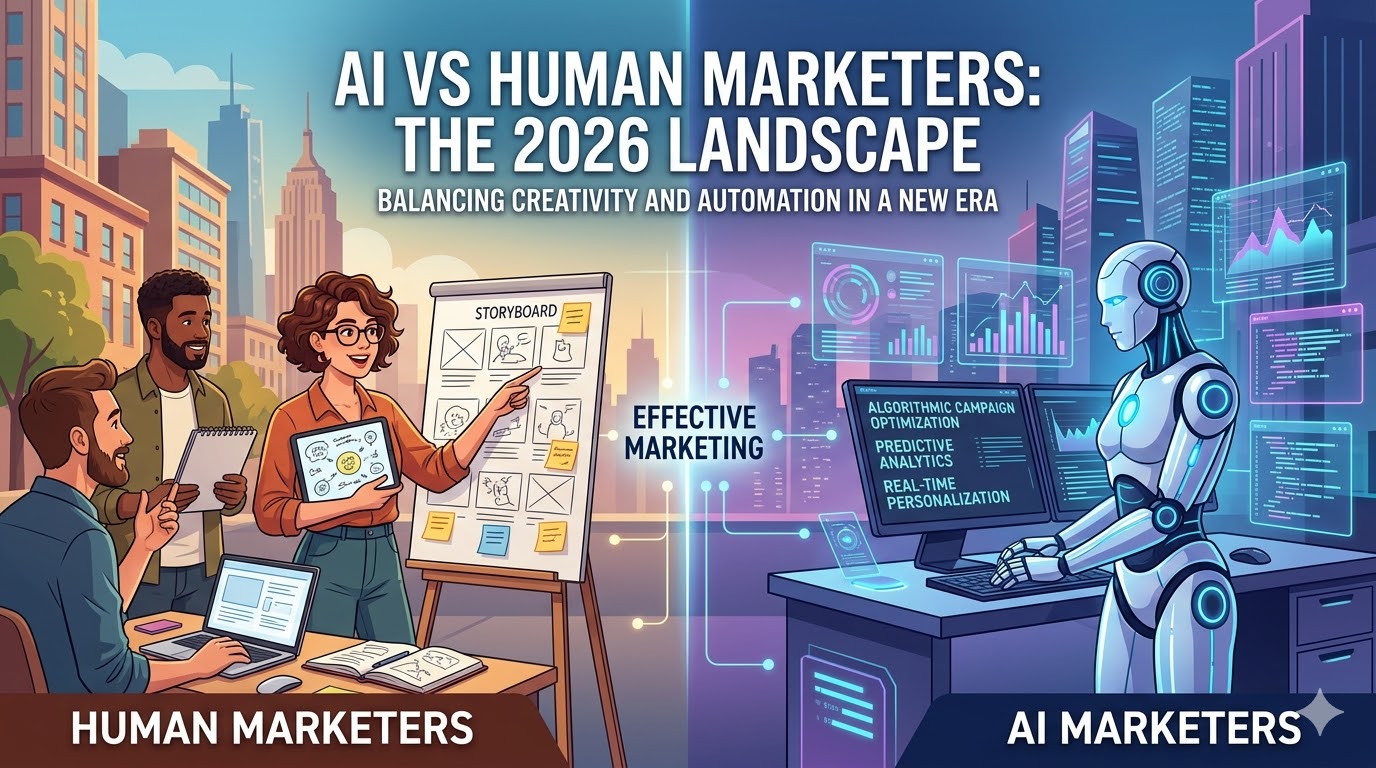
Every year, the "will AI replace marketers?" conversation gets louder. In 2026, the answer is clearer than ever: it's not a replacement — it's a redistribution of work.
Where AI Dominates
Let's be honest about where machines have already won. These aren't predictions — they're facts on the ground in 2026:
Data analysis at scale. AI processes millions of data points across campaigns, channels, and customer segments in seconds. No human team can match this speed. Predictive analytics tools now forecast campaign performance with 85%+ accuracy before a single dollar is spent.
Personalization engines. Dynamic email content, product recommendations, and ad creative variations — AI handles personalization across millions of touchpoints simultaneously. This used to require teams of 20+. Now it requires one person managing the AI.
Content production for SEO. Programmatic SEO pages, product descriptions at scale, meta tag optimization, and A/B testing of headlines — AI produces these faster and often better than humans, because it can test thousands of variations in real time.
Media buying and bid optimization. Automated bid strategies have outperformed manual media buying for three years running. The speed advantage is insurmountable.
Where Humans Still Win
Here's where it gets interesting — and where marketers should be doubling down:
Brand voice and emotional storytelling. AI can write competent copy. It cannot create a brand that people love. The campaigns that go viral, the taglines that become cultural references, the stories that make people cry — these still come from humans who understand the messy, irrational, beautiful complexity of human emotion.
Strategic judgment under uncertainty. Should we enter this market? Is this controversy an opportunity or a threat? How do we position ourselves during a cultural moment? These decisions require intuition, experience, and an understanding of context that AI simply doesn't have.
Relationship building. B2B marketing, influencer partnerships, community management — anywhere trust matters, humans matter. AI can help you find the right people. It can't be the right person.
Creative direction. AI is an incredible tool for execution. But the creative brief — the insight, the angle, the "what if we tried this" — still needs a human mind that can connect dots no algorithm would think to connect.
The Winning Formula for 2026
The marketers thriving in 2026 aren't choosing sides. They're using AI for everything it's good at (speed, scale, data, optimization) and redirecting their freed-up time toward what only they can do (strategy, creativity, relationships, judgment).
The losing strategy? Trying to compete with AI on speed and volume. Or ignoring AI and doing everything manually. Both paths lead to irrelevance.
The best marketing teams in 2026 look like this: small groups of strategic, creative humans augmented by powerful AI systems. They produce more, move faster, and think deeper than teams three times their size from just two years ago.
The question isn't "AI or human?" It's "which parts of my work should I hand to AI so I can focus on the parts that actually matter?"